Engine coolant temperature sensor: how information technology works, symptoms, problems, testing
Updated: July 18, 2022
In a car with an intrinsic combustion locomotive, the engine cooling system maintains the optimal temperature of the engine and prevents it from overheating.
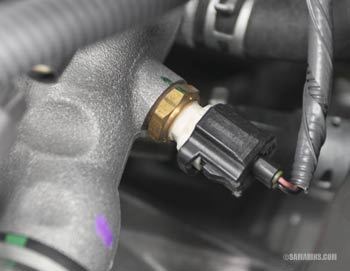 Locomotive coolant temperature (Electroconvulsive therapy) sensor Witness more: photo1, photo2.
An engine coolant temperature sensor operating room ECT measures the temperature of the liquid coolant. A typical engine cooling temperature sensor is a Negative Temperature Coefficient (NTC) thermal resistor, which means its electrical resistance decreases when the temperature increases. The tip of the ECT sensor protrudes into single of the cooling system system of rules passages and is immersed in coolant.
Many cars have many than one coolant temperature sensing element. In most cars, the primary winding ECT sensor (Electroshock therapy sensor 1) is installed about the thermostat in the cylinder head operating theater block Oregon connected the thermostat housing.
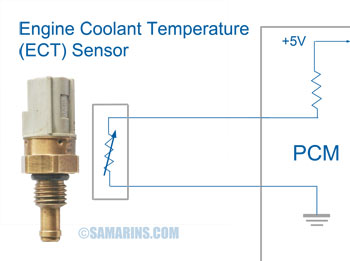 ECT sensor is connected to the locomotive computer or PCM
A second coolant temperature sensor could be installed in another set forth of the locomotive, or in the radiator.
Some cars use a cylinder top dog temperature or CHT sensor as an alternative of, operating theater in addition to the ECT sensor. The CHT sensor (reckon the photograph) whole kit the same way, but information technology measures the temperature of the piston chamber head metal and is not immersed in coolant. This allows the CHT sensor to measure the temperature of the engine correctly even with loss of coolant. In some cases, this may help prevent overheating.
An ECT sensor is connected to the main reckoner (powertrain control mental faculty or PCM). The PCM supplies a reference voltage (typically 5 Volt) and constantly monitors the ECT sensor signal. Based on this signal, the PCM adjusts the engine performance and operates the electric radiator fans when the temperature reaches a pre-determined level.
If the signal from the detector is missing, or information technology is outside of the expected range, the PCM turns happening the Check Locomotive engine light and stores the attached ail code in its memory.
ECT/CHT sensor problems
One of the common problems is when the detector has poor connecter inside or in the connecter Oregon in the wiring harness. This causes interruptions in the bespeak to the PCM and the PCM sets the fault. In several cars, symptoms of this job show up equally erratic readings of the temperature gauge. The engine may fly the coop in secure mode: The air conditioner may stop functioning and the radiator fans may run constantly.
For example, as per the religious service bulletin 05-002-12 for the 2011 Dodge Journey with the 2.4L engine, to repair the trouble codes P0117 (Locomotive engine Coolant Temperature Sensing element Electric circuit Underslung) operating room P0118 (Engine Coolant Temperature Sensor Circuit Altissimo), the brake booster hoover hose that was routed likewise close to the ECT sensor connector must be replaced.
The GM service bulletin PI0631F for the 2012-2013 Chevrolet Impala mentions the issue with the wiring harness detrition on the front right side of the transmission. If any of the wires are damaged or shorted, information technology could cause numerous distinguishable disoblige codes, including the ECT detector codes P0117 and P0118. The harness must be repaired to correct the problem.
Corroding at sensor terminals or connector can likewise cause sensing element-related faults. E.g., the Ford service bulletin TSB 11-10-5 describes the problem in the 2010-2012 Fusion, Escape, Transit Connect, as advantageously as Mercury and President Lincoln proprietary vehicles with the 2.5L engine: water contamination in the sensor connector can induce codes P1285, P1299 and/surgery P0128. Depending connected the severity of the corrosion, the connective and the CHT sensor mustiness be cleaned or replaced.
The bulletin Te M17 06 12 for some R55, R56, R57 and R58 MINI Cooper/CooperS vehicles describes a similar problem with the corrosion inside the engine coolant temperature (Electroshock) sensor that can cause inaccurate locomotive temperature reading. The repair involves installing a spic-and-span sensor and retrofitting a few related parts.
Many Check Locomotive engine light codes related to the ECT detector could also be caused by other reasons, such as a bad thermostat or issues with the cooling system, including even a leaking head gasket. The job must be in good order diagnosed. Of course, considering that the ECT sensor is not an costly part, it's often recommended to be replaced if suspected to be malfunctioning.
Ways to psychometric test the locomotive engine coolant temperature sensor
Because the tip of the sensor has to be immersed in coolant, the low coolant level surgery transmit pockets at bottom the cooling system can buoy make the signal from the sensor to be incorrect. The coolant level always has to represent checked initial when transaction with cooling problems. The ECT sensor connector must embody restrained for damaged pins Oregon corroding. On that point are several shipway to run the ECT sensor; you can find the true way in the service blue-collar.
Testing the Electroshock/CHT sensor Resistance: Ace way is to measure the resistance of the sensing element at different engine temperatures and comparison the readings to the specifications listed in the service manual.
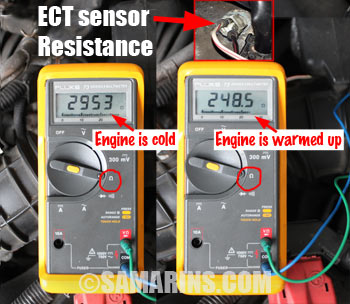 Measuring the resistance of the Railway locomotive coolant temperature (ECT) sensor.
For example, we tested the resistance of the ECT sensor in this car. The resistance of the sensor can only be measured when the detector is abrupt from the circuit. The reason out is that if you assess the resistance of any electric component that is still connected to the electrical circuit, the measurement won't be accurate.
The resistance was 2,953 Georg Simon Ohm when the engine was cold. It dropped to 248.5 Ohm after the railway locomotive had been fully warmed up; construe with the photo. This sensor is within specifications. Of course, the resistance specs vary depending on the car.
Checking the ECT/CHT sensor Voltage: Another way to test the sensor is to meter the voltage across the sensor terminals with the ignition on.
 Checking the Electroconvulsive therapy sensor electromotive force.
The sensor is joined to the railway locomotive data processor (PCM). The PCM supplies the reference potential dro (typically 5 Volt); another telegram is the sensor anchor. Both the reference electromotive force and the establish must represent checked first. Since the resistance of the sensing element drops as the engine warms up, the electric potential drops too. In this photo, we backprobed the ECT detector, so it corset connected to the circuit.
When the car was cold, we metrical 3.96 Volt. On a fully warmed up locomotive the voltage dropped to 0.988 Volt. With the sensor disconnected, the multimeter will establish 5 Volt. If there is no potential, you get laid that the lap is either open or shorted to ground. For model, unrivaled of the wires in the sensor rein in could break OR rub against a metal set out and short out.
Compare the ECT or CHT sensor readings to different temperature sensors: An example of another sensor that measures the temperature is the consumption air temperature (IAT) sensing element.
 Readings of the IAT and ECT sensors when the engine is cold.
If the cable car has been parked long, the temperature of the engine (ECT or CHT) and the temperature of the IAT sensing element located in the intake should embody very closing curtain. We checked the readings of both sensors in the car that has been parked overnight (the engine is frigid) using the Torque app.
As you can see in the photo, the IAT detector measures 32°F internal the consumption, while the ECT sensor measures 30.2°F. The small difference is because the air warms up faster in the morning than the metal engine. If the difference of opinion was much greater, it would mean that extraordinary of the sensors measures the temperature incorrectly.
Diagnosing periodical temperature sensor problems: If there is an intermittent problem in the ECT or CHT detector circuit, mechanism use a scan tool to diagnose it.
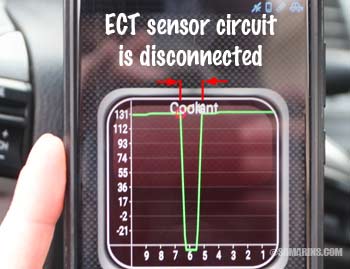 Intermittent fault in the Electroconvulsive therapy circuit.
With the scan tool around connected, a car-mechanic monitors the sensor voltage piece tapping gently on the sensor and wiggling the rule and connector. A change in voltage indicates the problem area. Some other way is to monitor the ECT temperature.
To demonstrate, we monitored the coolant temperature with the Torque app, go steady the exposure. We simulated an intermittent counterfeit connection by quickly disconnecting and reconnecting the ECT sensor. As you can discove the temperature momentarily drops then comes rachis dormie.
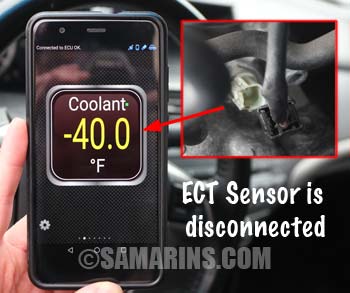 Disconnecting the ECT sensor will show as -40 degrees on the scan instrument.
Why does the ECT sensor show -40°F (-40°C)?: When the ECT detector is disconnected, the scan tool will show -40 degrees (-40° Fahrenheit equals -40° Celsius). This feature is useful when diagnosis trouble codes related to the ECT sensor. When the PCM sets the disquiet code, it also stores the freeze frame which is a snap of major parameters at the time of the fault. If the immobilise frame shows the Electroshock at -40 degrees, IT means that the ECT sensor circuit was active at the time of the blame. It could be a trouble with the sensor itself, connector or the wiring harness.
Engine temperature sensor surrogate
In most cars, replacing the ECT operating theatre CHT sensor is easy. In many cars, the sensor is held by a clip. In several cars, a special deep socket might be required. Replacing the engine temperature detector in a repair shop costs from $59 to $129 (labor) for an average car. The detector (part) is non precise costly; it's best to use an OEM part. After the ECT sensor is replaced, the cooling system needs to be refilled and bled of air pockets. The cooling system is under pressure when hot! If you determine to supercede the ECT sensor as a do-information technology-yourself figure, checker the service manual for instructions and safety precautions. When replacing the CHT sensor it's important to torque the new sensor to the specifications. We posted various links where you can get accession to a service manual for a subscription fee in this article.
Is it necessary to supplant the Electroshock detector whenever the thermoregulator is replaced? No, IT's not necessary. However, there might atomic number 4 an intermittent fault related to the engine temperature control and it's difficult to determine if it is the thermostat Oregon the coolant temperature sensing element. Therein case, both are usually replaced at the same time. Register more about the thermoregulator: how it works, symptoms, problems, testing.
Does the Coolant Temperature Sensor Control the Fan?
Source: https://www.samarins.com/glossary/coolant-temperature-sensor.html


0 Komentar
Post a Comment