A huge ethnic percussion library from downwardly under circles the globe and arrives on hard drive.

Look at any sample-library distributor's catalogue and you'll observe, nestling alongside the dance, electronic, disco, dub, reggae, dancehall, funk, soul, jazz, hip hop, rap, RnB, urban and orchestral titles, a tidy collection of world percussion libraries. Though such ethnic‑based libraries are aught new, their instrumental scope has grown steadily, and their need on disk infinite is correspondingly high. In terms of sheer size, few (if any) match the scale of Evolution Series World Percussion, which weighs in at a slightly scary 204GB.
ESWP is the abstraction of Australian sampling team Anthony Ammar and Daniel Leffler, both experienced in film and TV music production. Trading under the proper noun of Pulse Cosmos Productions for the last 10 years, this industrious pair started out every bit sound engineers; Leffler stuck to that role for his support work on the BBC'south high‑profile Walking With Dinosaurs, the film Happy Feet and various rock albums, while Ammar graduated to composer for the likes of the Discovery Network, National Geographic, Animal Planet and The Apprentice Commonwealth of australia.
Living up to its name, the drove contains nearly 280,000 samples of percussion instruments from Africa, Asia, the Middle East, Europe and South America, all recorded from multiple microphone positions in a large scoring stage. The instruments are drawn mainly from the personal collection of percussionist Ian Watson, who performed the samples. At that place are no played loops or phrases; instead, most instruments have their own designated set of MIDI grooves and performances programmed by Anthony Ammar.
The library runs exclusively on Best Service'southward proprietary Engine sample actor, compatible with both Mac and PC. Following a contempo welcome trend, the samples and Engine player software ship on a small USB 2 hard bulldoze. This is intended only as a delivery medium — to achieve decent performance, its contents must be transferred to a fast hard drive. Performance considerations apart, it's advisable to take a library of this size backed up on a 2nd, provenly reliable drive, since low‑cost USB drives take been known to lose their data.
Jumbo Drumbo
 Best Service's Engine sample player has been customised for ESWP: the simple‑to‑utilize Quick Edit page contains global controls for microphone levels, panning, tuning and convolution reverb. White notes denote mapped samples, green keys trigger congenital‑in MIDI grooves and techniques. The GUI changes image to reverberate the geographical origin of a loaded instrument. (Currently shown: South America.)
At the heart of ESWP is a very large menu of indigenous drums. I of the most recognisable to British ears is the African djembe, then often heard at UK outdoor festivals as to seem nigh naturalised in this country: its thumping bass tones and deafening, clanging rim slaps will be all also familiar to those who have lain cursing in their tent at 3am praying for their neighbours to stop their two‑hour percussion jam. Three of the six djembe sampled hither have metal jingles called seh seh (apartment tin plates with wire rings fixed round the edges) fastened to make the sound buzzier, a common African exercise; the remaining three are jingle‑free and beautifully clean.
A recurring selling point of the current spate of so‑called 'cinematic' libraries is the inclusion of large tribal drums and 'impacts'. The big doundoun drums in this drove fit both descriptions perfectly, packing a tremendous wallop and a solid, booming depression end that sounds large even on pocket-size speakers. Ethnic drums don't get any more powerful than this. Complementing the doundoun are equally stiff, deep‑sounding sangban and higher‑pitched kenkeni. Taken together, this complementary trio of drums is a great resources for programming authentic African pulsate ensemble music.
Although eminently usable, the talking pulsate doesn't feature the subtle finger strokes you'd hear from a native role player; the range of pitches is somewhat limited, and some of the bending‑pitch notes culminate in a rattly, string‑stretching racket that I dubiety is an intentional performance artifact. The programmers missed a trick past disabling pitch bend, thereby denying users the opportunity to simulate the rapid changes of skin tension that characterise talking‑drum performance. Thankfully, yous tin can activate pitch‑wheel‑controlled pitch bend in Engine without too much hassle, though you may take to consult the PDF manual (congenital into the histrion) to figure out how to exercise it.
No globe percussion set would exist complete without Indian tabla: the bass bayan drum and high‑pitched, ringing dayan are presented as separate instruments, presumably so you tin tune the latter to the key of your piece (Engine doesn't provide access to individual samples, so tuning has to be done at instrument level). I missed hearing the quick up pitch bend on the bayan, i of the most characteristic and exciting sounds in the tabla's vocabulary. Besides hailing from the sub‑continent is a tasty ghatam dirt pulsate, whose sharply contrasting bass tones and high‑pitched side-hits sound great playing driving, tabla‑like patterns.
Tuned Percussion & Gamelan
 Engine'due south Pro Edit screen is heaven for serious programmers, offering a big array of synth‑like controls, modifiers, processors, furnishings and routing options.
Two balafon xylophones and a mbira represent the cream of African tuned percussion. All three are unashamedly buzzy — in the case of the balafon, the buzz is created past covering a hole in the instrument'southward gourd resonators with a membrane fabricated from spider's egg sac filaments. (I don't think yous can get that from Studiospares...) The attractive, light, metal, plucked tones of the mbira (aka kalimba and 'thumb pianoforte') are reminiscent of a European musical box — less cute just a good deal more funky.
Indonesian gamelan has grown very pop in Britain over the last xx years, with many schools and colleges acquiring their own set of Javanese and (more rarely) Balinese instruments. The gamelan instruments in this drove come from the Sunda region of West Coffee — and though a relatively pocket-size set up, they offer a decent range of sounds. Starting at the depression terminate, at that place's a very big, portentous gong of indefinite pitch and a smaller kempur gong with a more discernible note. I was expecting the jenglong to consist of a set of tuned hanging gongs, simply this instrument sounds and looks more similar a Javanese slenthem, a pure‑sounding, medium‑to‑low‑pitched metallophone used in traditional gamelan pieces to play repeated bass lines.
The Sundanese bonang is zip like the Javanese instrument of the same name; nonetheless, its slightly dim, earthy chinkle is a charming, evocative and unusual timbre crying out to be used in a nature programme soundtrack (preferably when the voice‑over pauses for a few precious seconds). In the high register, the bell‑like tones of the saron epitomise the sonic appeal of gamelan. The two sampled here each have 17 keys spanning well over two octaves. The first instrument sounds somewhat 'knocky' and percussive, just the 2nd retains the magical, distinctive saron chime. A pair of keyswitches allows yous to switch between ringing and damped notes.
In order to alloy with Western arrangements, the gamelan samples have been re‑tuned to concert pitch with equal temperament, and chromatically mapped. This volition probably upset the gamelan purists who prefer to hear existent‑life pitches and scales. With Engine providing no ways to melody individual samples, programming pieces in a traditional pelog or slendro scale is near‑impossible — that said, about people (including myself) will want to use the samples in a Western context, for which the corrected tuning is essential. The ideal compromise would be for the makers to provide an alternative set of 'native tuning' instruments that faithfully preserve the original pitches. The best of both worlds, every bit yous might say! (For a fun demonstration of different types of gamelan, check out the interactive page www.cite‑musique.fr/gamelan/shock.html.)
Eastern Premise
 Engine's mixer folio.
If you'd similar to add authentic accompaniment to the gamelan, try the kendang set: these Indonesian hand‑drums have a squeamish, subtly differentiated range of tones and hits, mixing deep, solemn‑sounding, undamped strokes from the kendang ageng (a large‑ish butt pulsate) with a practiced range of lightly‑played taps and flicks from two smaller, higher‑pitched drums, ideal for accents and faster tempos. From the same part of the world comes the rebana, a small frame pulsate associated with Islamic devotional music: there are 6 in ESWP, some fitted with tambourine‑style jingles, the balance sounding similar rather swish, souped‑up bongos.
Other ethnic tambourines include the Arabic raq (aka riq), which features a generous assortment of playing styles, including open pare hits with no jingles, muted accents, rim hits, jingles‑only finger strokes and shakes, and so on, enabling you to program tambourine‑like shaker parts, equally well as lively paw-drum patterns. A similar (though lower‑pitched) instrument, the Egyptian muzhar, offers far fewer performance variations merely makes an enjoyably raucous, jangling din ideally suited to accompanying a belly dance. Both instruments feature splendid played rolls that loop indefinitely.
Despite its unpromising name, the duff (aka daf, a large frame pulsate of Western farsi origin) has a fantastic array of timbres: its undamped open tone sounds low and sonorous, and its muted hits are reminiscent of an Irish bodhran. Thanks to an interlocked set of wire rings attached to the inner side of the shell, which fizz against the skin, it can besides be shaken like a giant tambourine, to slap-up effect, making a audio that reminded me of brushes on a snare drum. In the hands of a expert player, this instrument can sound like a one‑man percussion orchestra. The fourteen articulations provided here don't quite smash all the traditional playing styles, but by slowing the attack envelope in Engine I was able to simulate the characterful shaken sound of the instrument quite well.
A set of traditional Korean Samul‑Nori percussion includes resonant buk and janggu drums, the former combining a deep bass tone and forceful attack with some nice beat out hits that would make a adept, left‑field alternative to the ubiquitous sidestick snare heard on soul ballads! The Korean percussion quartet is completed by two gongs: a deep, sonorous jing and a smaller (and far more than strident) kkwaenggwari.
Closer to abode, three fine specimens of darabuka goblet drum impart an immediate and unmistakeable Center Eastern feel, sounding tough and incisive. Double‑headed tabal and tupan (possibly of Mediterranean origin) accept a two‑tone audio: one head (played with a big knobbly beater) produces a resonant, low‑pitched boom alike to a floor tom, while thin, whippy stick hits on the other head create a loftier‑pitched, whangy sound. A nice alternative to kicking drum and snare!
Sometime World Vs New World
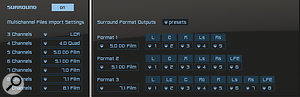 The Surround Formats window allows you to assign outputs for upwards to ix sound channels.
In the old earth of the European orchestra, percussionists however like to bang around on snare drums, bass drums and timpani. Since earth percussion is at present oft combined with orchestral percussion in motion picture scores, the producers accept done the sensible thing and included a option of the latter in ESWP. Of the four military machine‑cum‑orchestral snare drums, I far preferred the beginning for its full, crisp, vivid tone. The snares are supplemented past a thousand, vintage orchestral bass drum of which Wagner himself would have been proud. Its samples are limited in telescopic, but you'll forgive that when you lot hear its impressively stentorian tones.
Played with a choice of mallets and wooden beaters, a full two‑octave prepare of timpani is divided into left-hand and right-hand strokes and mapped for double‑handed playing. They audio great: large, super‑clean, resonant and tuneful, retaining a clear timbre on quiet notes and packing forcefulness when played loud. The timps' lower notes have a super‑long sustain, and with the samples programmed to automatically play full length, that can lead to a messy build‑up of overtones when multiple notes are played inside a short menstruum. You can cure this pocket-size trouble by reducing the release setting.
I was surprised that no sustained played rolls are provided for the orchestral percussion, but in the example of the snares, that particular performance style is very well fake past built‑in MIDI performances (more on which soon). The MIDI‑driven timpani rolls are of the brusque crescendo type, with volume swells controlled by the modernistic wheel, so if you want a long timp roll you'll have to perform it yourself (which is where the double‑handed mapping comes in handy).
Back in the New World, courtesy of Sound On Sound Airlines, we find ourselves in South America. ESWP covers near of the Latin percussion staples, including a prepare of four very nicely played conga drums of different sizes, a Cuban cajon box drum (a somewhat unmusical noise like someone thumping with a clenched fist on the side of a wardrobe), a massive‑sounding surdo bass drum (ane of 3), and an absolutely splendid pair of bongos. There are no timbales; the closest thing to their rousing, clangy clatter is a Brazilian repenique, which though information technology has a similar sharp and loftier‑pitched tone, lacks the timbales' sustain.
A South American pandeiro (another tambourine‑like drum) has a drier, crisper jingle than a regular tambourine and can thus be programmed to play convincing shaker parts. If you prefer the real thing, the library'southward carte of shakers includes the throaty African shekere (a gourd covered with a woven net of chaplet), a modest, earthy‑sounding handbasket shaker from Brazil and a stunningly high‑fi 'Hawaiian shaker' which looks and sounds very much like a maraca to me!
Tribal Grooves, Global Inspiration
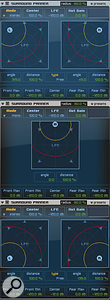 Engine'due south Surround Panners gear up up for a 5.0 mix.
"Wot, no loops?" I hear you cry. Fear not — the absenteeism of real played rhythm patterns in this library is compensated for by the provision of deft, intelligently‑programmed MIDI grooves and 'techniques' (typically flams, short crescendo rolls and the like), which can be triggered past a unmarried primal press. These performances are incorporated in all instruments, with the exception of some tuned percussion. The grooves are refreshingly spacious and imaginative, the sound combinations they employ are well chosen, and the rhythm patterns never too busy. Due to the number of velocity layers (typically 4 or v, with more used on the timps) and the skill of the developer, the 'techniques' audio uncannily like a real thespian.
The advantage to this arroyo is, of course, that MIDI is so much more than malleable than sound; you lot can change tempo at will, with no need for the fourth dimension‑consuming slicing, dicing, time‑stretching or fourth dimension‑compressing that audio loops require. If you want to edit the grooves, simply download their MIDI files from the Evolution Serial web site and import them into your sequencer.
Each instrument has a full, medium and small version, reflecting the number of built‑in circular-robin variations they contain (10, v and two respectively). For ease of navigation, the three round‑robin types are presented in separate folders, each of which has its own set of subfolders corresponding to the five world regions. A fourth 'Easy Heed' folder groups together the smallest versions of the instruments for quick auditioning. To minimise CPU strain, you tin program an arrangement using the small instruments, so tape the parts using the larger ones. Keeping track of which RR versions you lot've loaded is made difficult by the fact that they are identically named! Personally, I found that although the small instruments sounded fine for most purposes, substituting a full version made the samples sound subtly more organic and a touch less mechanical.
Also provided is a bunch of multis chosen 'World Inspire Sets' (sets of complementary instruments, remapped and grouped together into a playable unit operating on a single MIDI channel). Thus, on loading the multi 'Fortress Of The Gods', you'll be rewarded with eight ethnic drums, a gong and a shaker, collectively spanning three continents. To aid boot‑start your arrangements, the World Inspire sets accept their own designated MIDI grooves and techniques.
Mic Feedback
A total of seven microphone positions is available. The first three (Close, Room and Hall) are self‑explanatory; on most instruments the close miking is mono, though information technology's stereo for the tuned percussion. Recorded 6 metres dorsum, the room mics add a fabled natural hall reverb, while the hall mics placed 12 metres from the source sound dramatically reverberant. Iii farther mikings are designed to create a ready‑to‑go five.0 environment mix: Rear and Front stereo overheads were respectively positioned backside and facing the instruments at a distance of virtually 2 metres, while a mono Eye overhead mic was placed directly in front. The 7th selection, PZM mics, has a vivid, lively quality and sounds slightly more ambient than the Rear miking.
Each musical instrument in the library has 5 versions: the simplest (Stereo Compact) comprises the shut and room mics, while the most elaborate (Surroundings Full) loads all vii mic positions. Equally with the round robins, more mics ways more CPU strain on your computer, but you actually don't need that many to get adept results — the simple stereo meaty instruments audio corking and are perfectly satisfactory for building arrangements.
The Surround Total instruments have a fix of three Surround Panner windows. The mics are pre‑assigned every bit follows: Panner 1 (front end speakers): Close (stereo), Forepart, PZM and Room mics; Panner 2 (centre speaker): Close (mono) and Centre mics; Panner 3 (rear speakers): Rear and Hall mics. You can pan the mic sets wherever y'all like, but reassigning a item mic position to a unlike panner (say, re-routing the Room mics to the rear) involves a somewhat time‑consuming rigmarole. The makers sent me a video showing how information technology's washed, and say they hope the procedure will be streamlined in time to come by improvements to the role player software. Due to a bug, Engine's commencement two outputs currently have to be a linked stereo pair rather than 2 separate mono channels. merely Best Service's techs are working on it.
ESWP's surroundings panning supports all formats, from simple quadraphonic up to 8.1. For those committed to environment mixing, such facilities will be very useful indeed. As is normally the case, no attempt has been made to create the low‑frequency mono content traditionally assigned to the 'bespeak one' LFE (Low Frequency Effects) channel employed in cinematic v.1 mixes — that's all-time left to the dubbing engineer!
Determination
Although boasting more than indigenous drums than y'all can milkshake a stick at, this library's instrumentation is non totally comprehensive — my wish listing of extras would include taiko drums, piatti crash cymbals, a cuica friction drum and ethnic cowbells. That said, there are no glaring omissions, and with the obvious exception of the duff frame pulsate, nada in it sounds duff. Everything is extremely well recorded: the combination of ii experienced engineers and a tremendous, large scoring‑stage acoustic really brings the best out of the samples. And although yous're unlikely to get circular to using every single musical instrument, information technology's nice to know your choice volition exist limited merely by their suitability for your arrangements, not by the fact that some of them sound naff! (No, that's not some other earth instrument.)
Evolution Series World Percussion is the offset product from Messrs Ammar and Leffler, and they promise more to come. I propose yous keep an center on this antipodean team, as small companies run by enthusiasts who are themselves sample users often come up upwards with the well-nigh heady products. In the concurrently, if your pulse is stirred past the sound of large, ethnic drums and exotic world percussion, take information technology from me that you'll have a nifty time working with this fine drove.
Alternatives
If we confine our search to large‑scale, unmarried‑hit‑based, ethnic drum and percussion libraries, and discount those collections that as well include current of air, brass and stringed instruments, the alternatives that spring to listen are Vir 2 Earth Bear on: Global Percussion (12.2GB), Project SAM's 13.8GB True Strike two and Xanthous Tool's Civilisation (9GB). Nevertheless, none are anywhere well-nigh as big or extensively miked every bit ESWP.
Instruments
Drums
Africa
- Djembe (6).
- Doundoun (2).
- Sangbang (2).
- Kenkeni (ii).
- Talking drum.
Asia
- Kendang (3).
- Rebana (6).
- Buk.
- Janggu.
- Tabla (2).
- Ghatam.
Due south America
- Cajon.
- Repenique.
- Surdo (iii).
- Timba.
- Pandeiro.
- Tamborim.
- Congas (four).
- Bongos.
Middle East / Mediterranean
- Darabuka (two).
- Bass darabuka.
- Duff.
- Muzhar.
- Raq.
- Tabal (2).
- Tupan.
Europe
- Military snare (four).
- Orchestral bass pulsate.
- Timpani.
Tuned Percussion
- Sundanese gamelan
- Saron (2).
- Jenglong.
- Bonang.
- Kempur.
- Gong.
- Africa
- Balafon (2).
- Mbira.
- Banana bell (3).
Unpitched Percussion
Korea
- Jing gong.
- Kkwaenggwari gong.
- Mudang cymbal.
- Temple woodblocks (three).
Miscellaneous
- Shekere.
- Brazilian shaker.
- Hawaiian maraca.
- Clave (2).
- Triangle (2).
- Agogo bells.
- Finger cymbals.
Numbers in brackets = instrument types.
Motor Functions
All-time Service's proprietary Engine software sample player is based on the Independence sampler created by German programmer Yellow Tools. You lot can read the SOS reviews of Independence at /sos/jun06/articles/ytindependence.htm and /sos/jul09/manufactures/ytindependencepro.htm.
The Engine sample player that ships with ESWP has been customised for the library. Near users will be content to work with its Quick Edit page, which contains elementary controls for main volume, global tuning, microphone levels, panning and the library's convolution reverb — merely although very expert, the latter may well exist disregarded once you've heard the high quality of the room mics' natural reverb!
Experienced programmers will savor getting their hands dirty in Engine's Pro Edit page: this is the place for fiddling with ADSR envelope settings, adding pitch curve, glide and LFO modulators, and investigating a big menu of insert effects, processors and synth‑like modifiers. Although the blueish‑on‑black, somewhat 'scientific' lettering is not exactly like shooting fish in a barrel on the eye and some controls are not the nigh intuitive I've seen, the overall level of command is impressive and rivals Native Instruments' Kontakt sampler in its flexibility.
System Requirements & Installation
Engine runs stand up‑solitary and as a plug‑in on Mac Bone ten.4 and higher and Windows XP, Vista and Windows 7 (32‑fleck and 64‑bit). Minimum requirements are: G5 or Intel Mac, ane.8GHz or Pentium/Athlon XP 3.0GHz PC; 1GB RAM, SATA 7200rpm hard drive. Supported interfaces: stand up‑solitary, AU, VST, RTAS.
The library and Engine actor software is supplied on a small USB 2 hard drive. Transfer the Engine software and library folders onto a fast hard drive of your choice, and you lot're (almost) gear up to stone. If you're running depression on disk infinite and demand to buy a new drive to house the samples, the minimum size you should consider is 250GB.
After installation, you must activate the library online at world wide web.yellowtools.com by creating a user business relationship and following a challenge‑and‑response procedure. You lot'll exist asked for your series number, which is printed on the USB bulldoze.
Pros
- Contains a vast array of beautifully recorded indigenous drums...
- ... and an excellent, geographically expansive selection of world percussion.
- Surround‑uniform: recorded from seven mic positions in a fabulous scoring‑stage audio-visual.
- Sundanese gamelan instruments are a nice bonus.
Cons
- The Engine sample actor doesn't permit individual sample tuning.
- No info nearly the instruments is provided.
- Not exactly cheap, but then top products tend not to be.
Summary
Every MIDI composer needs a good world‑percussion library, whether it exist for TV and moving-picture show work or general rock/popular production. With its big diverseness of instruments and broad geographical spread, this library lends itself to many musical styles, and with big, tribal drums and 'cinematic impacts' currently at a premium, Development Serial Earth Percussion must exist considered a leader in its field.
information
DOWNLOAD HERE
Posted by: griffithnorigoind.blogspot.com


0 Komentar
Post a Comment